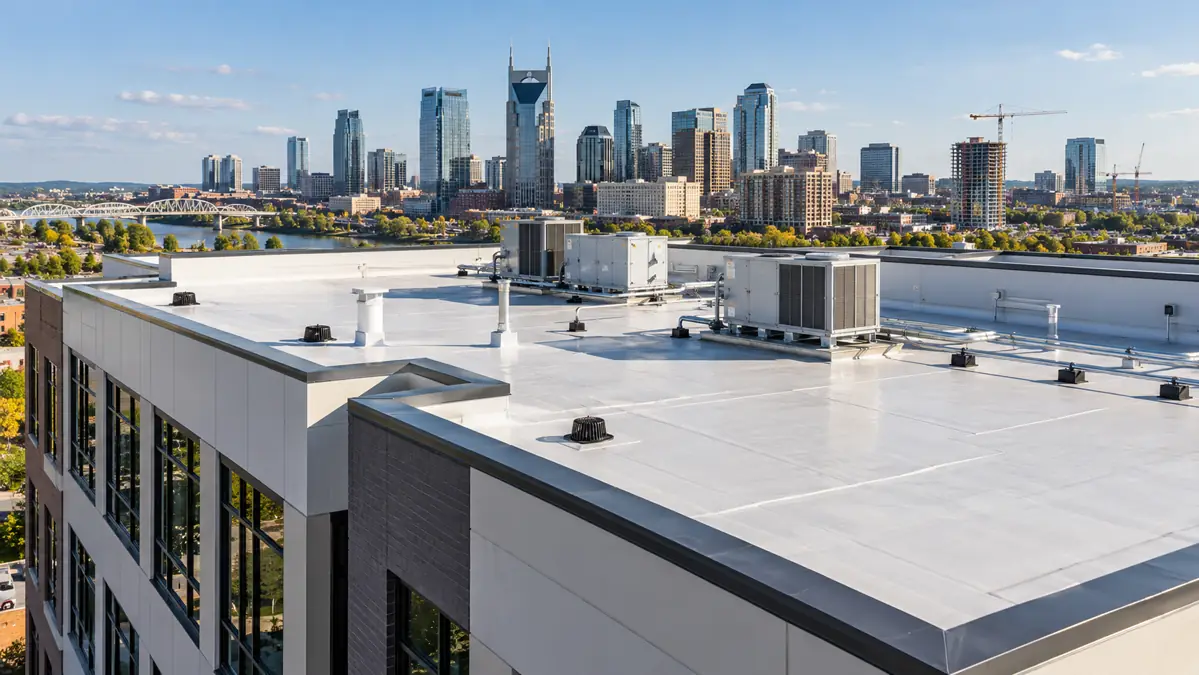
The best commercial roof is not determined by a product name alone. Building use, roof slope, drainage, existing materials, insulation, rooftop traffic, and long-term ownership plans all affect the decision. Nashville property owners may encounter low-slope membranes, standing seam metal, older built-up assemblies, and coated roof systems across warehouses, retail buildings, offices, and mixed-use properties.
A commercial roofing contractor in Nashville should evaluate the full assembly before recommending TPO, metal, or a restoration coating. Here is how the main options differ.
TPO Roofing for Low-Slope Buildings
Thermoplastic polyolefin, commonly called TPO, is a single-ply membrane used on many commercial roofs. Sheets are attached or adhered over an approved substrate, and the seams are heat-welded to form a continuous surface.
TPO is often considered for warehouses, retail spaces, offices, and other buildings with low-slope roofs. Its light-colored surface can reflect solar energy, although actual energy performance also depends on insulation, roof color, building operation, and local conditions.
Installation quality is critical. Seams, penetrations, drains, curbs, and perimeter details must be completed correctly. The condition of the deck and existing insulation also matters. Covering wet insulation can trap moisture and undermine the new system, so a contractor may recommend test cuts or moisture testing before finalizing the scope.
Metal Roofing for Durability and Defined Drainage
Commercial metal roofing is commonly used on warehouses, manufacturing facilities, agricultural buildings, offices, and steep-slope architectural sections. Standing seam panels use concealed clips and fasteners, which allows controlled movement as the metal expands and contracts.
Metal can provide a long service life when the design, gauge, coating, fasteners, seams, and transitions suit the building. Still, metal roofs are not maintenance-free. Contractors should inspect panel laps, exposed fasteners, sealant joints, penetrations, closures, edge conditions, corrosion, and areas where water collects.
For an occupied property, ask how panel removal, equipment access, falling debris, and interior exposure will be managed. The proposal should also clarify whether gutters, downspouts, wall panels, skylights, or rooftop equipment are included.
Roof Coatings for Suitable Existing Systems
A coating can restore the weathering surface of some existing commercial roofs. Common systems include silicone, acrylic, and other elastomeric products selected for the substrate and site conditions. The work usually involves cleaning, repairs, seam and penetration treatment, primer when required, and application at a specified thickness.
Commercial roof coating systems can be useful when the roof is a sound restoration candidate. They may reduce tear-off, improve reflectivity, and extend service life. They are not a shortcut for severe saturation, unstable decking, chronic drainage failures, or widespread structural deterioration.
Contractors should confirm adhesion and compatibility, identify wet areas, and explain how ponding water will be addressed. Ask whether the quoted application rate meets the manufacturer’s requirements and how thickness will be verified during installation.
How the Options Compare
| Consideration | TPO | Metal | Roof Coating |
|---|---|---|---|
| Typical use | Low-slope commercial roofs | Sloped roofs and metal buildings | Restoration of compatible existing roofs |
| Main installation focus | Welded seams and penetrations | Panel seams, clips, fasteners, and transitions | Preparation, repairs, adhesion, and thickness |
| Tear-off potential | Depends on existing assembly and code limits | Depends on deck and existing system | Often limited when the roof qualifies |
| Key inspection issue | Moisture below the membrane | Corrosion and movement at details | Substrate condition and trapped moisture |
Factors That Affect Cost and Service Life
Square footage is only one pricing factor. Access, roof height, deck repairs, insulation, drainage work, edge metal, penetrations, tear-off, equipment protection, and occupied-building logistics can materially change the price. Warranty requirements may also dictate approved components and installation methods.
Routine inspections help protect any system. Address punctures, loose flashing, clogged drains, failed sealant, and storm damage before water reaches insulation or interior finishes. Titan also provides commercial roof repair for isolated leaks and service needs.
Choose Based on Evidence From the Roof
Start with a documented assessment rather than a preferred product. The contractor should identify the existing system, moisture concerns, drainage performance, repair history, and remaining serviceability. Then compare options using expected ownership period, disruption, maintenance, warranty coverage, and total scope.
Titan Roofing can inspect your Nashville commercial property and explain whether TPO, metal, coating, repair, or replacement fits the building. Request an assessment before budgeting around a system that may not match the roof’s actual condition.